




EAE Barcelona analyses the future of logistics, talent and artificial intelligence at SIL 2026
The School led two roundtable discussions, one on supply chain transformation and the other on the integration of artificial intelligence in talent management, at Europe’s leading logistics event.
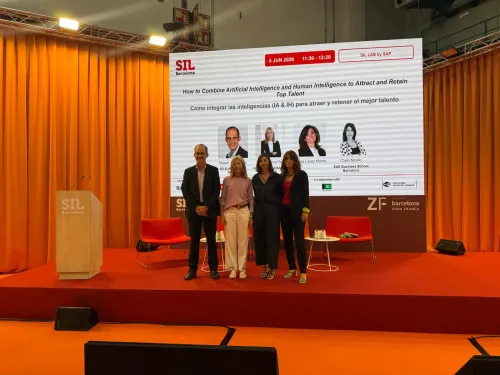
EAE Barcelona, which forms part of the Planeta Formación y Universidades higher education network, recently took part in the latest edition of the SIL International Logistics Exhibition, Europe’s largest meeting point for the logistics and supply chain sector. At the event, the School led two roundtable discussions focusing on some of the key challenges currently facing organizations: supply chain transformation and the integration of artificial intelligence into talent management.
EAE Barcelona’s participation highlighted how data, technology and people must converge to drive more resilient, competitive organizations that are better prepared for the future.
The Future of the Supply Chain: Data, Foresight and Talent
Entitled “Future Perspectives for the Supply Chain”, the first session featured Miquel Serracanta, Director of EAE Barcelona’s Master in Supply Chain, and Tomás Colonel, founder of Symphio and a graduate of the School.
The discussion examined how digitization, artificial intelligence and the strategic use of data are redefining supply chain management in a context shaped by geopolitical tensions, regulatory changes and market volatility.
Serracanta highlighted the importance of organizations’ capacity for foresight to anticipate developments. “Companies need to make faster and better decisions. Demand planning is essential to anticipate rather than simply react. The ability to use data to foresee risks and respond before problems arise is one of the keys to operational excellence.”
With respect to talent, he explained how the skills in the highest demand logistics sector have evolved. “In the past, recruitment was driven mainly by experience. Today, we look for professionals who can speak the language of data, manage the future, collaborate across all areas of the organization and embrace a mindset of lifelong learning.”
He also highlighted the need to combine analytical capabilities, strategic vision and communication skills in order to tackle the new challenges facing the supply chain sector.
In conclusion, he placed particular emphasis on the human factor: “We must ensure that we treat talent with respect, develop it and take care of it. Ultimately, the answer is still people.”
For his part, Tomás Colonel pointed out that one of the greatest impacts of artificial intelligence on the supply chain lies in the speed of analysis and the improvement of data quality. “The major challenge remains having access to reliable information and being able to use it quickly. That is where AI provides a clear competitive advantage.”
However, he stressed the need to preserve human judgement in decision-making, particularly in relation to ethical issues, and underlined the importance of continuous learning and interpersonal skills for the professionals of the future.
Artificial and human intelligence to attract and retain talent
The second roundtable discussion, “How to integrate intelligences (AI & HI) to attract and retain the best talent”, brought together representatives from the fields of human resources, academia, talent acquisition and applied AI to discuss how technology and the human factor can be combined in people management.
Moderated by Miquel Serracanta, the session featured Chelo Morillo, the Vice Dean of EAE Barcelona, who stressed that “it is essential to stay up to date because AI has burst onto the scene with huge force, creating a genuine wave that is pushing us towards it”.
From an academic perspective, the Vice Dean explained that education must go beyond technical learning: “We are interested in ensuring that, when our students join organizations, they not only know how to use AI tools, but are also capable of leading AI-driven organizations and generating strategic value from them.”
The role of human leadership in the age of AI
During the discussion, Morillo also underlined the risks associated with delegating recruitment processes entirely to algorithms. “AI must be trained and supervised by people. If we feed an algorithm with biased historical data, it will end up reproducing the same biases. The question is not only whether bias exists, but who supervises it and according to what criteria.”
The Vice Dean argued that human skills will continue to be a differentiating factor in an increasingly automated environment, highlighting empathy, critical thinking and ethical judgement in particular. Moreover, she also advocated a people-centred leadership model: “We need deeply human leaders who are capable of understanding every area of the organization and making informed decisions. Technology is advancing rapidly, but human judgement must progress even faster. The companies that will succeed in the future will be those that invest in their people’s capacity for lifelong learning.”
As a closing message, she summarized the role that technology should play within organizations: “AI is the most powerful co-pilot we have ever had, but it should never be behind the wheel and steering the decisions made by a company. There must always be a human in the driving seat.”
EAE Barcelona drives the debate on logistics, talent and innovation
EAE Barcelona’s participation at SIL 2026 reinforces the School’s commitment to training professionals who are equipped to lead the transformation of logistics, people management and business innovation in an environment increasingly shaped by data and artificial intelligence.
Through initiatives such as this, the School strengthens its involvement in some of the most important debates shaping the future, in this case those concerning the labour market and the supply chain.