




Talent EAE 2026: AI will redefine employment, prioritizing potential over résumés, experts explain
EAE Business School Barcelona has held the round table Talent Talks: Future of Work 2026, the New Intelligence of Talent, as part of Talent EAE 2026, its annual employability event.
The session brought together experts from Deloitte, Google, Telefónica and NEX.ia of Planeta Formación y Universidades to analyze how AI is impacting the labor market, the evolution of professional profiles, and the need to promote upskilling and reskilling.
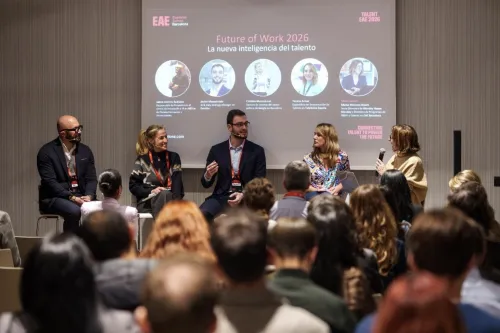
The labor market is beginning to focus more on potential than on résumés. This was one of the conclusions of Talent Talks: Future of Work 2026, the New Intelligence of Talent, the round table organized by EAE Business School Barcelona, part of the higher education network Planeta Formación y Universidades, within the framework of Talent EAE 2026, the tenth edition of its annual employability event that connects students with companies.
The meeting, held at the Hotel Catalonia Plaza in Barcelona, brought together experts from companies such as Google, Deloitte, Telefónica and Planeta Formación y Universidades to analyze how AI is impacting the labor market, the evolution of professional profiles, and the need to promote upskilling and reskilling.
POTENTIAL GAINS GROUND OVER RÉSUMÉS
During the round table, moderated by Maite Moreno, Director of HR and Talent Programs at EAE Business School Barcelona, participants discussed how the concept of talent has evolved and which attributes are currently most distinctive. The experts agreed that the idea of talent is undergoing a profound transformation.
Teresa Aznar, Talent Acquisition Specialist at Telefónica Spain, highlighted that “we are no longer looking for impeccable résumés. Today, potential carries much more weight than track record,” and emphasized that in this new context, “human skills do not expire; technical skills do.”
From the perspective of innovation and artificial intelligence, Jaime Andrés Rubiano, Project Lead at the Innovation and AI Center at NEX.ia of Planeta Formación y Universidades, stressed curiosity as a key differentiating factor: “Young people use AI extensively, but when it comes to building tools with it, the percentage drops.” In his view, “the key lies in turning ideas into something tangible.”
AI TRANSFORMS PROFESSIONAL ROLES, BUT DOES NOT REPLACE TALENT
Regarding the evolution of professional profiles, the experts noted that the labor market is not eliminating roles, but transforming them. “Many professions are not disappearing; they are mutating,” Rubiano stated. In the same vein, Aznar explained that “profiles are becoming hybrid” and that organizations are increasingly seeking “a cross-functional vision, business mindset, and focus on impact.”
On the real impact of AI at work, Javier Maquirriain, AI & Data Strategy Manager at Deloitte, explained that “AI already has a clear impact on automatic and repetitive tasks,” although he warned that “its main limitation remains context.” Aznar added that “AI does not replace professionals; it complements them,” and that “final decision-making and responsibility remain human.”
ETHICS AND RESPONSIBLE USE OF AI
The round table also addressed the ethical challenges associated with AI adoption. Cristina Montserrat, Public Sector Account Manager at Google in Barcelona, reminded attendees that “AI does not perform magic,” and warned that “if the data is biased, the outcome will be too,” which explains why many organizations are prioritizing internal projects before launching AI-based solutions externally.
To close the session, the experts agreed that future talent in the world of work will rely on a combination of attitudes and capabilities such as adaptability to change, teamwork, innovation, curiosity, and purpose.