



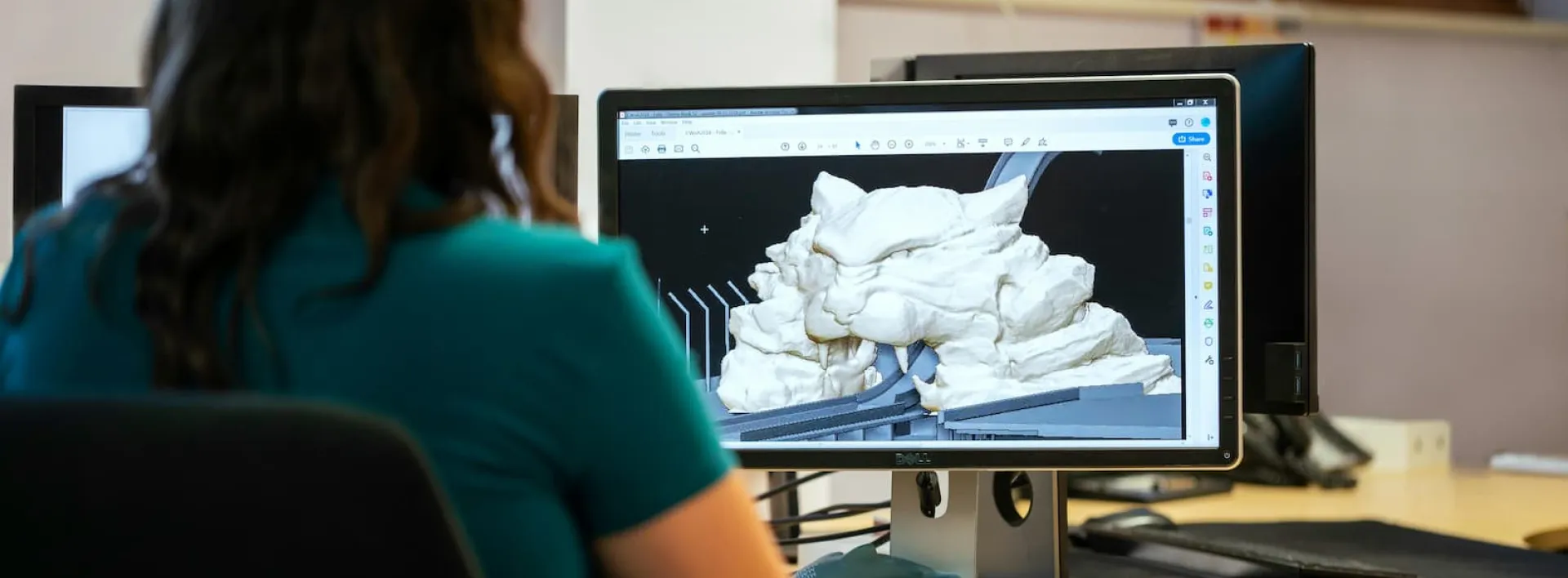
How Digital Twins Are Revolutionizing Business Management
Digital transformation is not only about adopting new technologies, but also about integrating innovative tools that optimize processes and enhance decision-making. In this context, digital twins, or virtual replicas, have become an emerging and disruptive trend. By combining Big Data, Artificial Intelligence, Machine Learning, and the Internet of Things (IoT), digital twins are transforming the way companies design, produce, maintain, and manage their products and processes.
What are digital twins and how do they work?
The term digital twin refers to the creation of a virtual replica of a physical object, process, or system. This digital replica stays synchronized with its real-world counterpart throughout its entire lifecycle, from the design and development phase to operation, maintenance, and even decommissioning. In this sense, digital twins are virtual representations of physical objects, processes, or systems that remain connected to their real counterpart throughout their lifecycle. This technology makes it possible to monitor, simulate, and optimize performance using real-time data.
The concept was introduced in 2001 by Michael Grieves within Product Lifecycle Management (PLM). It is based on three key elements: the physical object, its virtual representation, and a real-time data connection system. Through sensors and IoT platforms, the digital twin continuously receives information, enabling better decision-making, reducing failures, and improving development and maintenance processes.
Main applications of digital twins in business
The versatility of digital twins means that they can be applied across a wide range of industries and services, improving both internal processes and customer experience.
In manufacturing, digital twins optimize production and maintenance by predicting failures before they happen, reducing downtime. In aerospace and healthcare, they allow for simulations and testing that improve safety and performance in critical systems. In supply chains, digital twins help optimize transport and inventory management, reducing bottlenecks and improving logistics.

Examples of digital twins in companies
Leading companies are already using digital twins with strong results. In the automotive sector, they are used to simulate vehicle performance and improve production efficiency. In sports, especially Formula 1, digital twin simulations allow teams to adjust parameters and enhance performance before cars hit the track.
In the energy sector, companies such as Chevron use this technology to predict failures in platforms and refineries, reducing maintenance costs. General Electric has expanded the use of digital twins to wind systems, monitoring key parameters such as turbine rotation speed and power output to optimize operations and reduce wear.
In healthcare, digital twins support surgical planning and personalized treatments, improving patient care. Cities like Singapore have also adopted this technology to manage urban infrastructure, optimizing traffic and energy consumption. In entertainment, they are used to create immersive experiences and virtual avatars, opening new possibilities in digital interaction.
Types of digital twins
Digital twins can be classified based on their function and scope. The Digital Twin Prototype (DTP) is a virtual model used during the design and development phase to validate concepts before production. In contrast, the Digital Twin Instance (DTI) is the digital replica of a system in operation, used to monitor and optimize its performance.
Depending on their application, digital twins may focus on products, processes, or entire systems. In addition, the Digital Twin Environment (DTE) integrates these representations into a single digital ecosystem to improve real-time data management and analysis. To gain deeper expertise in these systems, programs such as a Master in Management STEM or a Master in International Business STEM are strong options.
Benefits of digital twins
Digital twins offer significant advantages for businesses. By simulating processes and detecting issues early, they help reduce costs and development time. It is estimated that they can reduce product validation time by 20 to 50 percent and lower operating costs by 10 to 15 percent.
In addition, once a product has been sold, companies can offer predictive maintenance services, using real-time data collected from sensors to anticipate failures and schedule interventions before serious issues arise. This approach improves operational efficiency and can generate additional revenue, increasing profitability by 5 to 10 percent in some product categories.
Product quality also improves thanks to early detection of design issues and performance simulations. At the same time, real-time data integration supports more informed decision-making, allowing companies to anticipate problems and optimize operations. Another key benefit is innovation. Digital twins drive the development of new and more personalized products and services, helping companies adapt to market needs and enhance customer experience.
Finally, one of the greatest advantages of digital twins is the ability to run tests and simulations under controlled and variable conditions. This is especially valuable in industries where system behavior is critical, such as aerospace or medical device manufacturing. With a virtual model, it is possible to anticipate anomalies, risks, and errors, enabling preventive and predictive actions.
Digital twins in business: key factors for implementation
For successful implementation, several factors must be considered. First, a strong technological infrastructure is required, integrating IoT, Big Data, cloud computing, and Artificial Intelligence. Data quality and integration are also essential to ensure an accurate representation of the physical system.
Cross-department collaboration is equally important. Not only IT teams should be involved, but also design, production, and maintenance departments. Training employees to use this technology and building a digital culture are key to successful adoption.
Finally, security and privacy must be addressed carefully, ensuring the protection of real-time data and compliance with current regulations. When implemented correctly, digital twins become a powerful tool for digital transformation and business optimization.
Related programs

Master in Management
Business ManagementEAE’s Master’s in Management STEM will teach you how data science can generate new business models and better...
- Full time
- October 2026
